 This review originally appeared in the Summer 2003 issue of Catholic Home Educator, which is no longer published.
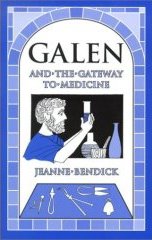
Galen and the Gateway to Medicine
(Living History Library)
Written and illustrated by Jeanne Bendick
2002, Bethlehem Books
152 pages
Archimedes and the Door of Science by Jeanne Bendick is not only a favorite among homeschoolers, but is also one of those books that has withstood the test of time. Originally published in 1962, it is one of Bethlehem Books’ bestsellers of today.
Now Jeanne Bendick has done it again. Though eighty-years old, Mrs. Bendick wrote and illustrated Bethlehem’s newest title Galen and the Gateway to Medicine. In the first week that this book was in my home, it was picked up and read by my three oldest children. I simply left it lying around as I wanted to read it myself, but every time I turned around a different child had taken it from under my nose.
The general consensus in my house is that Mrs. Bendick’s newest title is a hit. Just as she did with the Archimedes book, she brings an ancient character to life and shows us how his life and his work is still relevant today.
Galen was a Greek living in the times of Roman rule. A physician, Galen saw anatomy as fundamental. Based on his work as a surgeon to Roman gladiators, and his animal dissections (dissection of human corpses was forbidden), Galen described cranial nerves and heart valves and showed that arteries carry blood, not air as was believed at that time. In extending his findings to human anatomy he was sometimes in error, however his findings were the standard for the next 1,300 years.
Galen wrote nearly 300 works, of which about 150 survive to this day. As they were translated, his influence spread throughout the Christian and Muslim worlds. A revival of interest in Galen’s work during the Renaissance led to new anatomical studies. Many of his ideas were then overthrown when Andreas Vesalius wrote On the Structure of the Human Body (1543), which includes descriptions of the human anatomy, based on his own dissections. Later William Harvey correctly explained blood circulation in Anatomical Exercise Concerning the Motion of the Heart and Blood in Animals (1628).
Even though Galen’s theories had to be corrected, his philosophies, based largely on Hippocratic concepts, helped to create a foundation of respect for the human person and spirit in medicine.
Reading Jeanne Bendick’s latest book Galen and the Gateway to Medicine will provide many lessons for your homeschooled child, from science to history to philosophy. I highly recommend it.
JEANNE BENDICK, a graduate of Parsons School of Design, is the author and illustrator of many books, primarily in the field of science. Her work has always been distinguished by her remarkable ability to express complex concepts in simple language, and to make difficult subjects interesting and comprehensible to the general reader. Among her many books are Mathematics Illustrated Dictionary, How Heredity Works, Eureka! It’s Television!, The First Book of Space Travel, The First Book of Automobiles, and The First Book of Airplanes.

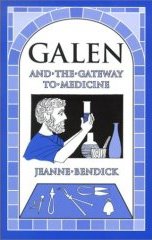

 Photo by


