Tuesday, January 31, 2006

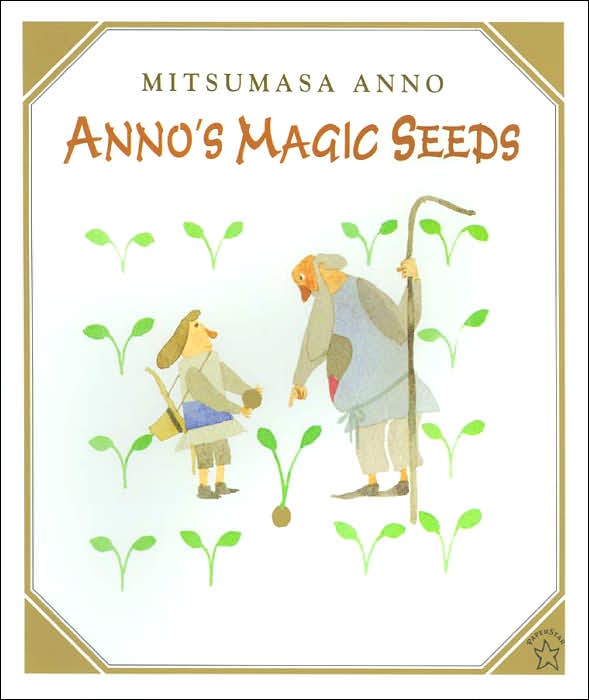
Anno's Magic Seeds


Anno's Magic Seeds
Written and illustrated by Mitsumasa Anno
June 1999, Putnam Juvenile
40 pages

Mitsumasa Anno's books are popular at my house. They are math-themed books, yet fun. This title is not only good for teaching math, but the importance of thrift as well as how the commerce of farming came to be (make sure to read the end notes in the book).

In this story, Jack receives two magic seeds from wizard. He is instructed to bake and eat one, and plant the other. The seed he eats satisfies his hunger for an entire year. The planted seed grows into a plant that produces two more seeds.

Year after year, Jack follows the same routine; he bakes and eats one while planting the second. Finally, Jack decides to plant two seeds and forgo eating one, making do without. The year following, Jack has four seeds: one to eat and three to plant. The second year he has six seeds: one to eat and five to plant. How many seeds will he have the third year?

In the sixth year, Jack meets Alice. Jack shares with Alice. In the seventh year, they are married and they share the seeds with the wedding guests. In the eighth year, Jack and Alice have a baby.

Soon Jack begins to warehouse some of the seeds and selling others at market. The equation of the seeds grows more complicated each year.

In the end, the family is hit by a hurricane. Their crop and most of their stored seeds are destroyed. Jack, Alice, and their child begin a new life with their last few seeds, praying to God for a good crop.

Tuesday, January 24, 2006

Wild Fibonacci

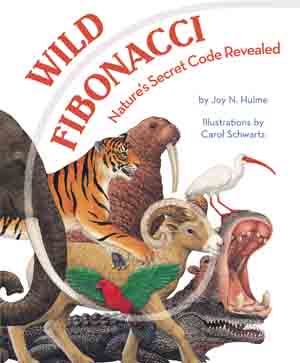
Wild Fibonacci: Nature's Secret Code Revealed
Written by Joy N. Hulme
Illustrated by Carol Schwartz
August 2005, Tricycle Press
32 pages


1, 1, 2, 3, 5, 8, 13, 21, 34, 55, 89

Do you see a pattern in these numbers?

Each number is the sum of the two numbers previous to it. They're called Fibonacci numbers and the neat thing is that they're found all through nature, in both animals and plants.

Wild Fibonacci: Nature's Secret Code Revealed introduces these numbers to preschoolers in a very simple way.

I love a picture book that teaches me, as the parent, something even though the book with written for little children. If you read the introduction of this picture book, you'll learn a little something about the Fibonacci sequence discovered in 1202, a very interesting topic. Then you can take that knowledge and share with your child as you read the story to him or her.

Some other books on the Fibonacci Sequence (check your library for these or search on keyword: Fibonacci, to find other titles):
Fascinating Fibonaccis: Mystery and Magic in Numbers by Trudi Hammel Garland (Dale Seymour Publ.) for middle school.
Fibonacci Fun: Fascinating Activities With Intriguing Numbers by Trudi Hammel Garland (Dale Seymour Publ.) reproducible activities for upper grade school and middle school.

Some weblinks on Fibonacci numbers:
Plant Spirals
Explanation of Fibonacci Numbers
Explanation of the Golden Section

Hat tip to Field Learning.

Thursday, January 19, 2006

Interactive Periodic Table

This is a really cool website: Interactive Periodic Table of the Elements.

Use the hyperlinks in the left column to manipulate the Table. You can change it to show the full names of elements instead of their symbols, to show their date of discovery, melting point, etc. You have it display only halogens, rare earth elements, noble gases, etc.

The best part, I think, is that you can click on any element within the Table and learn ALL about it.

Great little learning tool.

Tuesday, January 17, 2006

Thursday, January 12, 2006

Red Flag: Q is for Quark

I so wanted to recommend this title to you all. I so wanted to love it. After all, I loved its predecessor, G is for Googol. But, it wasn't meant to be. As hard as I tried, I can't love it and I can't recommend it.

The idea behind Q is for Quark is great. An ABC book for middle school kids that is both inviting and informative.

However, as I read through the book I began to find something here and then something there that I would have to contradict and explain to my children why we, as Catholics don't agree with the author.

For example: C is for Clone. The author mentions that there is a controversy, but doesn't properly explain the deep moral reasons behind the controversy. In his own words:

A worldwide debate continues to rage over whether or not cloning is a good thing. Lots of people worry that cloning humans is next, which they view as morally wrong. Who would get to decide which people could be cloned? What would stop a very rich person from making many clones of himself or herself?

On the other side of the debate, some people think cloning humans would be great. Through cloning, you could achieve a sort of "immortality" as a young "you" started all over! And even if we didn't clone whole people, we could clone organs and tissues from the same people who need them for transplants.

No mention of the human embryos whose lives would be terminated in order to retrieve those organs.

There were some other little things that bothered me regarding sperm, evolution, Darwin, AIDS. At first, I thought that these little things could be glossed over and would provide me with the opportunity to talk about our beliefs versus the beliefs held by secularists. However, in the end it was just too much.

What a shame that I can't just hand this to a child and say, "go enjoy this."

Sunday, January 08, 2006

Euclid Online

There's a really nice edition of Euclid's Elements available online.

(Hat tip - Redeem the Time)

Monday, January 02, 2006

Living Math Forum

Just in case you don't belong to enough Yahoo discussion groups, here is a really cool one to check out: Living Math Forum. The focus is on teaching math through real books.

The accompanying website is: Living Math. It has lots of great articles and book ideas. A word of caution, the webmaster has not reviewed all of the books herself. I have found a few to contain adult material or anti-Catholic bias.

And of course, as The Thrifty Homeschooler, I checked the books out of the library instead of purchasing them.