Tuesday, April 25, 2006

Natural Learning: Science for Littles

(Cross post from The Thrifty Homeschooler)

In preparing a foundation upon which to build science skills, we must first ask ourselves "what is exactly is science." Science is so much more than the simple collection of facts. Science is about observation. Yes, we need to know basic facts such as the boiling point for water and that the earth is the third planet from the sun, but we also need to remember that those facts were first discovered by observation.

Young children love memorizing facts and so teaching them science facts such as the order of the planets, would be both fun and useful. But I encourage you to do more than that. Teach them observation skills.

There are four parts to observation:
Ask what is happening.
Predict what might happen.
Test your prediction.
Make sense of the results.

Science involves trial and error, it is a way of thinking. Children learn science best if they are encouraged to investigate and experiment. Young children love to see, to touch, to manipulate. They like to how things change.

When babies throw their plate off the highchair and onto the floor, they are not being bad, they are observing. They wonder what will happen if the plate goes over the edge. They may even be making a prediction. They test the prediction and then try to makes sense of the results. You might say that the are testing the theory of gravity. (Someone else may say that they are testing your patience.)

In cooking, let children observe how the butter melts, how the texture of the bread dough is different from the finished loaf, or how vinegar curdles milk. Ask her why she thinks these things happen.

Take walks outdoors and observe the night sky. How does it change from day to night? From night to night? From season to season? Ask why he thinks these changes take place.

And none of this costs a penny.

Tuesday, April 18, 2006

IntelligentProject.net

Ignatius Press has a new site with articles on science and faith at IntelligentProject.net

Monday, April 17, 2006

ScienceNews for Kids website

A fantastic Science website for kids!

Searching on the internet for some illustrations I am working on, I bumped into what seems to be a fantastic and fairly new science website for kids: Science News for Kids.
ScienceNews has been arriving weekly in this house since the pre-history of our family life, and it provided interesting reading material for many of those seemingly endless nursing hours. Now this website has the same professional production quality and fascinating vignettes of news from the world of science. There are many categories to choose from, such as agriculture, animals, chemistry, earth, behavior, physics, weather and more.
The online subscriptions are free and easy to submit. Also, there is a teacher zone with resources for each article.

There are also some fun activities on the top bar: puzzle zone, gamezone, SciFizone, and even a Science fair (with reports on real science fair projects) and lab zones. These are fun, educational games for kids with no innapropriate content.

Click on it this week to read (and see pictures) on the recently discovered 10th planet, the 100th anniversary of the great San Francisco earthquake and Saturn’s Strangely Warm Moon.

Happy Science learning!

Friday, April 14, 2006

Vatican Lecture at Milwaukee Public Museum

Why Does the Pope Have an Astronomer?
A brief history of the Vatican Observatory

April 25, 2006, 7 p.m. Milwaukee Public Museum

The roots of the Vatican Observatory go back to the Gregorian Reform of the Calendar in 1582, and it has been part of an extensive history of Church support for astronomy (Galileo to the contrary!) Its modern mission for the last hundred years is to show there is no inherent conflict between science and religion by simply being people supported by the Church whose sole mission is to "do good science". We'll look into the history of this activity, including a summary of what's being done at the Vatican Observatory today.

Brother Guy Consolmagno received degrees in Earth and Planetary Sciences from the Massachusetts Institute of Technology, and his Ph. D. in Planetary Science from the University of Arizona in 1978. He took vows as a Jesuit brother in 1991 and serves as curator of the Vatican Meteorite collection. Today, he divides his time between Tucson, Arizona, where he observes asteroids and Kuiper Belt comets with the Vatican's 1.8 meter telescope on Mt. Graham, and Castel Gandolfo, Italy, home of the Vatican meteorites.

Cost: Free for Museum members & students with ID, $5 for general public.
Reservations required, so please call Reservations on (414) 278 2728 to make your booking.

Click here for more information

Brother Guy Consolmagno is also the author of Turn Left at Orion: A Hundred Night Sky Objects to See in a Small Telescope - and How to Find Them.

Tuesday, April 04, 2006

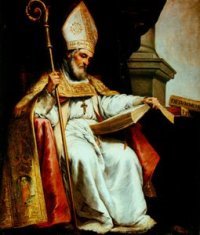
St. Isidore and Science


From Why Homeschool:

On this date, April 4, 636 AD
Isadore, Bishop of Seville, collected science lore into his twenty volume Originum seu Etymologiarium libri XX. The Originium, incomplete at his death on April 4, 636, was edited and issued by his friend and disciple Bishop Braulio. Without Isidore's efforts, the Medieval world would have been much poorer of knowledge.

And Don't forget, St. Isidore of Seville is the Patron Saint of the Internet. Pray for us St. Isidore!!!

Saturday, April 01, 2006

The Fight About Science and Christianity

Dr. Thursday has a great snippet from Fr. Stanley Jaki about the fight about Science and Christianity and modern secularism's desire to insist that they are at odds with each other.

Answering Catholic creationists: an article in Homiletic & Pastoral Review

Homiletic & Pastoral Review has been a mainstay for our marriage's Catholic intellectual life. Although we have subscribed to many other good Catholic magazines, HPR is the only one we have uninterruptedly subscribed since the early days of our family life. Having lived in seven different American dioceses in the past 20 years, the consistently high quality content of the monthly sermons alone has been worth the price of the subscription. A few years ago Ignatius Press took over the publisher and has recently launched a website with sample articles and contents of the current issue among other things. On my last visit I noticed that a most timely article is available here.

The article is entitled “Reading Genesis with Cardinal Ratzinger”, written by Nicanor Pier Giorgio Austriaco, who earned a Ph.D. in biology from M.I.T. in 1996 and a S.T.L. from the Dominican House of Studies in 2005. In the first part of the article, the author states his purpose:

“In this essay, I respond to the Catholic creationist movement by arguing that contemporary exegetes have sufficient reason to move beyond a literalist reading of the Genesis text. I will begin by summarizing the three hermeneutical principles employed by then Joseph Cardinal Ratzinger, now the Holy Father, Benedict XVI, in his non-literalist interpretation of the six-day account of Genesis, traditionally called the Hexaemeron. I will then show that his method is faithful both to the teaching of the Catholic Church most recently articulated in Dei Verbum, the Dogmatic Constitution on Divine Revelation of the Second Vatican Council, and to the teaching of his predecessor, Leo XIII, in Providentissimus Deus. Thus, I propose that Cardinal Ratzinger’s approach to reading Genesis, as a particularly noteworthy example of the hermeneutical method endorsed by Vatican II, should be paradigmatic for the contemporary Catholic exegete seeking to be faithful to the Catholic tradition.”

While this article may pose a somewhat challenging read for the layperson, I was still able to grasp its basic points and I was encouraged by the appearance of one more excellent piece to engage in a public dialogue on one of the more confounding issues debated within Catholic homeschooling circles.