Thursday, March 30, 2006

The Catholic Church and Science

How the Catholic Church Built Western Civilization by Thomas E. Woods Jr. PhD has some very helpful commentary and quotations on the historical relationship of the Catholic Church with science. Here is a sampling of quotations from major saints during the Middle Ages and the Renaissance taken from Woods' book:

Saint Robert Bellarmine (1542-1621):

If there were a real proof that the sun is in the center of the universe, that the earth is in the third heaven, and that the sun does not go round the earth but the earth round the sun, then we should have to proceed with great circumspection in explaining passages of Scripture which appear to teach the contrary, and rather admit that we did not understand them than declare an opinion to be false which is proved to be true. But as for myself, I shall not believe that there are such proofs until they are shown to me.


St. Albert the Great (1206-1280) :

It very often happens that there is some question as to the earth or the sky or the other elements of this world, respecting which one who is not a Christian has knowledge derived from most certain reasoning or observation, and it is very disgraceful and mischievous, and of all things to be carefully avoided, that a Christian speaking of such matters as being according to the Christian Scriptures, should be heard by an unbeliever talking such nonsense that the unbeliever, perceiving him to be as wide from the mark as east from west, can hardly restrain himself from laughing.


Saint Thomas Aquinas (1225-1274) :

First, the truth of Scripture must be held inviolable. Secondly, when there are different ways of explaining a Scriptural text, no particular explanation should be held so rigidly that if convincing arguments show it to be false, anyone dare insist that it still is the definitive sense of the text. Otherwise unbelievers will scorn Sacred Scripture and the way to faith will be closed to them.

Friday, March 24, 2006

Let's-Read-And-Find-Out Science

The Let's-Read-And-Find-Out Science series for children, published by HarperTrophy, has been a favorite in our house since our oldest was in Kindergarten. While the series has been around for decades - you can often find old copies (with terrible illustrations) in the library - the reissued series (beginning in the late 80s) is very informative with illustrations that range from charming to stunningly beautiful.

The series is divided into two "stages". Stage 1 is deemed suitable for preschoolers and kindergartners, while Stage 2 is a little more complex and intended for early grade school. Our favorites tend to come from Stage 2 and are much beloved even by the younger ones in our family.

The content in these books is substantial, but easy to grasp. They start with a very limited topic - take The Moon Seems to Change, for an example. Through simple, but clever illustrations and hands-on learning, this book explains the changes from new moon to full moon and back again.

Not only are these great to spark children's interest in science (and help answer some of their delightful questions!), but they're also a great refresher course for parents.

We haven't seen all the books in the series (and they keep coming out with new ones), so I'll just include a list of our favorites. I hope I don't forget any - these are the kinds of books I have to dig out from under the kids' beds and from all over the house. They are big time favorites around here...

Stage 1:

Animals in Winter
Baby Whales Drink Milk
How a Seed Grows
My Five Senses
My Hands
What Lives in a Shell?

Stage 2:

The Big Dipper
Falcons Nest on Skyscrapers
Flash, Crash, Rumble and Roll
Fossils Tell of Long Ago
How Do Apples Grow?
How Do Birds Find Their Way?
How We Learned the Earth is Round
The Moon Seems to Change
Snow is Falling
Sunshine Makes the Seasons
Switch On, Switch Off
What Makes a Magnet
What Makes Day and Night
Who Eats What?
Why Do Leaves Change Color?

You can purchase these from any bookstore, but we first heard about them from Michael Olaf.


Thursday, March 23, 2006

On Light Pollution

Tying in with Hedgemaker's post…

Did you know? Two–thirds of Americans cannot see the Milky Way from their backyard, and 99% of the population live in an area that scientists consider light polluted. The rate at which light pollution is increasing will leave almost no dark skies in the contiguous US by 2025.

http://www2.nature.nps.gov/air/lightscapes/


Monday, March 20, 2006

Making Blind Hamsters See

From Mark Shea's blog:

Cool Science: Nanotechnology has restored the sight of blind rodents, a new study shows.

Scientists mimicked the effect of a traumatic brain injury by severing the optical nerve tract in hamsters, causing the animals to lose vision.

After injecting the hamsters with a solution containing nanoparticles, the nerves re-grew and sight returned.

Friday, March 17, 2006

Creation, Evolution, and Intelligent Design

Confused about what the evidence is? Wondering what the Church teaches? I wrote this article in an attempt to clear things up: http://www.chcweb.com/catalog/files/evolutioncreation.pdf

Prime Numbers and the Sieve of Eratosthenes

There's a great math post today on G.K.C's Favourite

Tuesday, March 14, 2006

Happy Birthday Albert

Today is Albert Einstein's birthday as well as World Pi Day.

You can celebrate by eating a piece of pie at 1:59 PM (3.14159...). And check out some Einstein and Pi websites such as :

Albert Einstein Archives

Math Educators of Greater St. Louis (my hometown)

Pi Day

Basic information and trivia about Pi visit

An extensive web warehouse of info about Pi

Hat tip: Click Schooling

Physics and the Incorruptibles

The physics website PysOrg.com writes: Dead Greek Orthodox monk baffles scientists 15 years after burial.

Hat tip: Catholic Light

Wednesday, March 08, 2006

Spring Migration

There's an intriguing site called Journey North about the migration of butterflies, birds, etc. to North America.

Hat tip, American Chesterton Society blog.

Tuesday, March 07, 2006

The Birthday of Science

This is a fascinating post on the history of science as it relates to theology in the Middle Ages.

Monday, March 06, 2006

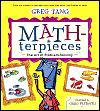
Math-terpieces: The Art of Problem Solving

Math-terpieces: The Art of Problem Solving
Written by Greg Tang
Illustrated by Greg Paprocki
June 2003, Scholastic Press
32 Pages

This is a fun book that combines math with art appreciation in a very inventive way. Each 2-page layout has a well-know work of art with a tidbit about the author. The book's illustrator uses a special feature from the painting to challenge the reader in counting and grouping skills.

For example, on the "Good Impressions" page, Van Gogh's painting White Water Lilies is there along with Paprocki's groups of lily pads drawn in Van Gogh's style. Tang then challenges the reader to "group lily pads to "make 8, four smart ways would be just great."

It can be shared with a preschooler to teach simple counting skills or with a grade school child to teach grouping or problem solving.

Other Titles by Greg Tang:
The Grapes of Math
Math for All Seasons
The Best of Times
Math Appeal
Math Fables
I have not yet reviewed all of these titles. Check your library first.

To learn more, visit Greg Tang's author website, www.gregtang.com