Showing posts with label living books. Show all posts

Saturday, August 08, 2009

Free E-Book: The Man Who Counted

We've talked about The Man Who Counted a number of times here and elsewhere. It's a favorite living math book and now it's available as a free pdf file. Personally, I'd rather have a real book to curl up with, but hey it's free!

The Man Who Counted

Monday, April 20, 2009

Math and Science Redo

UPDATE: Here's the link to the recorded event for free download: Bringing Joy to Your Math and Science Lessons. Everything went great!


I'm redoing the math/science webinar. If you missed the first one and you'll be around today at 2:00 PM Eastern (1:00 Central) then come join me.

I've rented a small (very small) office in town for my Homeschool Connections work. The Internet connection is awesome so my previous problems with audio and video glitches will now be nothing but a memory.

I hope to see some of you there!

Wednesday, April 08, 2009

Free Homeschool Resource: Math & Science Webinar


The math and science webinar went well last week. Oh, there were a few glitches (I'm always my worst critic) but the attendees loved it. If you weren't able to make it there, you can still attend the recorded event -- for free no less. You can watch it, download it, and even email it to friends.

Bringing Joy to Your Homeschool Math and Science Lessons:

Literature isn't just for reading! You can teach math, science, language arts, and more using living books. This is the third in a series of three talks on the topic of teaching through real books.

Have you ever said out loud, "I hate math!" Or, "Math was my worst subject!" Was science always a tough subject for you? Do you struggle wondering how you can bring the fullness of the subject to your children? If so, you've come to the right place.

In this talk Maureen Wittmann shows you how to let go of your math and science phobia and keep from passing it onto your children. Math can be fun and interesting. Really. You just need to look at it in a new light. Science can go beyond the kitchen experiments and come alive in a child's imagination. Really.

Maureen brings lots of books with her for show and tell. You'll leave this online seminar loaded with book titles, fresh ideas, and practical tips. You won't want to miss it!

Maureen is the author of For the Love of Literature: Teaching Core Subjects Through Literature published by Ecce Homo Press, available from your favorite bookseller or maureenwittmann.com.

Saturday, March 21, 2009

Thank You Ecce Homo


I am really happy to let you all know that Living Math is not the only sponsor for the upcoming webinar on teaching math and science through literature. Our other sponsor is Ecce Homo Press, publisher of the ever popular Little Flowers Girls Club and Blue Knights Boys Club materials, the Glory of America series, Little Women Hospitality Program, and more. They are also the publisher of my book For the Love of Literature which is the inspiration for this webinar.

The math and science webinar is already full with a long waiting list. If you didn't get around to signing up yet, don't fret as I'll make sure to let you all know when the recorded event is available.

In the meantime, thank you to all the Homeschool Connections sponsors!
Living Math
Ecce Homo Press
Love2Learn
mater et magistra

Wednesday, March 18, 2009

Thank You Living Math


I'm really excited to announce that Living Math will be one of our sponsors the upcoming math & science webinar. We're able to bring these homeschool webinars to you for free thanks to the generosity of our sponsors.

Make sure to check out Living Math's website where you'll find lots of tips and reviews to help you bring a true appreciation of math to your homeschool.

If you're planning on purchasing some living math books, please consider linking from the Living Math website as it helps them keep the website running.

Wednesday, January 28, 2009

Teaching Math and Science with Real Books

Here is a direct link to information on the Bringing Joy to Your Homeschool Math and Science Lessons webinar.

Webinar: Teaching Math and Science with Literature


UPDATE: All Homeschool Connections webinars are now free.

Save the date: April 1, 2009

I'm presenting an online talk on teaching math and science through real books at Homeschool Connections. I'd love to hear any suggestions or ideas from Unity of Truth readers. What would you like to hear in such a talk? I really love promoting real books in our homeschools. And the idea of teaching math with literature is really very foreign to most people.

I've given a similar talk several times before, but that talk encompassed all school subjects. What I'm doing for Homeschool Connections is break down that talk into three talks and expanding on each school subject. One in Feb. on history, one in Mar. on art and music, and one in Apr. on math and science.

I'll also talk about incorporating religion and faith into these subjects, how to efficiently use your library, building literature unit studies, how to bring joy into your homeschool studies and more.

If you're not familiar with webinars -- it's a really neat way to reach homeschoolers via the Internet. Especially those who may have a hard time getting to a conference or finding local suport or just needs something to beat the February Blahs. In fact, as a side note, Homeschool Connections is hosting free chats once a month -- Mom's Night Out While In -- starting Feb. 19th.

If you're interested in learning more, visit the website. There you can sign up for the free chats or future webinars. You can also download past webinars (click on: Recorded Sessions).

There is a fee for some of the events but you'll get more than your money's worth from these events. They're informative, motivating, and a plus to your homeschool.

The webinars are limited to 30 participants to keep it intimate. As I give the talk (you'll be able to see me via a webcam and I have a Power Point presentation you'll see too), you'll be able to participate in the chat room -- either sending questions or comments to me or to the rest of the audience. It's really all very fun -- I suggest giving it a try once or download the free webinar I did on Classroom Organization 101.

I look forward to hearing your ideas and suggestions!

Tuesday, July 29, 2008

Science at Library Thing

If you're looking for living books for science, from a Catholic homeschool mom's world view, then check out AtHomeScience's Library Thing. She has books from preschool to advanced and all are well tagged.

Get your library card out!


PS Check out her blog while you're at it: At Home Science

Saturday, July 19, 2008

Monday, March 06, 2006

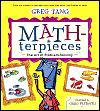
Math-terpieces: The Art of Problem Solving

Math-terpieces: The Art of Problem Solving
Written by Greg Tang
Illustrated by Greg Paprocki
June 2003, Scholastic Press
32 Pages

This is a fun book that combines math with art appreciation in a very inventive way. Each 2-page layout has a well-know work of art with a tidbit about the author. The book's illustrator uses a special feature from the painting to challenge the reader in counting and grouping skills.

For example, on the "Good Impressions" page, Van Gogh's painting White Water Lilies is there along with Paprocki's groups of lily pads drawn in Van Gogh's style. Tang then challenges the reader to "group lily pads to "make 8, four smart ways would be just great."

It can be shared with a preschooler to teach simple counting skills or with a grade school child to teach grouping or problem solving.

Other Titles by Greg Tang:
The Grapes of Math
Math for All Seasons
The Best of Times
Math Appeal
Math Fables
I have not yet reviewed all of these titles. Check your library first.

To learn more, visit Greg Tang's author website, www.gregtang.com

Tuesday, January 31, 2006

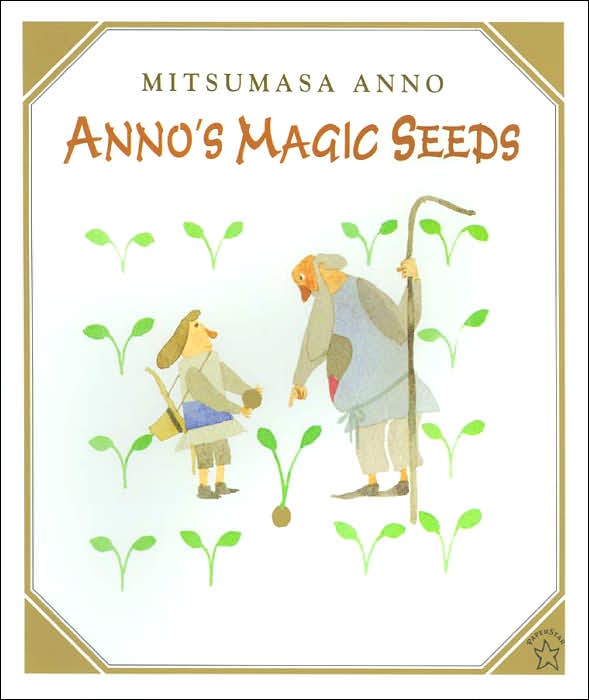
Anno's Magic Seeds


Anno's Magic Seeds
Written and illustrated by Mitsumasa Anno
June 1999, Putnam Juvenile
40 pages

Mitsumasa Anno's books are popular at my house. They are math-themed books, yet fun. This title is not only good for teaching math, but the importance of thrift as well as how the commerce of farming came to be (make sure to read the end notes in the book).

In this story, Jack receives two magic seeds from wizard. He is instructed to bake and eat one, and plant the other. The seed he eats satisfies his hunger for an entire year. The planted seed grows into a plant that produces two more seeds.

Year after year, Jack follows the same routine; he bakes and eats one while planting the second. Finally, Jack decides to plant two seeds and forgo eating one, making do without. The year following, Jack has four seeds: one to eat and three to plant. The second year he has six seeds: one to eat and five to plant. How many seeds will he have the third year?

In the sixth year, Jack meets Alice. Jack shares with Alice. In the seventh year, they are married and they share the seeds with the wedding guests. In the eighth year, Jack and Alice have a baby.

Soon Jack begins to warehouse some of the seeds and selling others at market. The equation of the seeds grows more complicated each year.

In the end, the family is hit by a hurricane. Their crop and most of their stored seeds are destroyed. Jack, Alice, and their child begin a new life with their last few seeds, praying to God for a good crop.

Tuesday, January 24, 2006

Wild Fibonacci

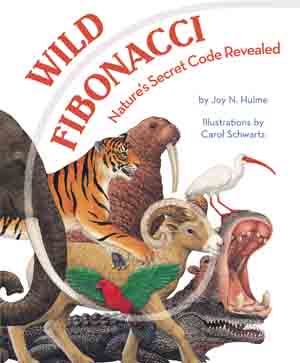
Wild Fibonacci: Nature's Secret Code Revealed
Written by Joy N. Hulme
Illustrated by Carol Schwartz
August 2005, Tricycle Press
32 pages


1, 1, 2, 3, 5, 8, 13, 21, 34, 55, 89

Do you see a pattern in these numbers?

Each number is the sum of the two numbers previous to it. They're called Fibonacci numbers and the neat thing is that they're found all through nature, in both animals and plants.

Wild Fibonacci: Nature's Secret Code Revealed introduces these numbers to preschoolers in a very simple way.

I love a picture book that teaches me, as the parent, something even though the book with written for little children. If you read the introduction of this picture book, you'll learn a little something about the Fibonacci sequence discovered in 1202, a very interesting topic. Then you can take that knowledge and share with your child as you read the story to him or her.

Some other books on the Fibonacci Sequence (check your library for these or search on keyword: Fibonacci, to find other titles):
Fascinating Fibonaccis: Mystery and Magic in Numbers by Trudi Hammel Garland (Dale Seymour Publ.) for middle school.
Fibonacci Fun: Fascinating Activities With Intriguing Numbers by Trudi Hammel Garland (Dale Seymour Publ.) reproducible activities for upper grade school and middle school.

Some weblinks on Fibonacci numbers:
Plant Spirals
Explanation of Fibonacci Numbers
Explanation of the Golden Section

Hat tip to Field Learning.

Thursday, January 12, 2006

Red Flag: Q is for Quark

I so wanted to recommend this title to you all. I so wanted to love it. After all, I loved its predecessor, G is for Googol. But, it wasn't meant to be. As hard as I tried, I can't love it and I can't recommend it.

The idea behind Q is for Quark is great. An ABC book for middle school kids that is both inviting and informative.

However, as I read through the book I began to find something here and then something there that I would have to contradict and explain to my children why we, as Catholics don't agree with the author.

For example: C is for Clone. The author mentions that there is a controversy, but doesn't properly explain the deep moral reasons behind the controversy. In his own words:

A worldwide debate continues to rage over whether or not cloning is a good thing. Lots of people worry that cloning humans is next, which they view as morally wrong. Who would get to decide which people could be cloned? What would stop a very rich person from making many clones of himself or herself?

On the other side of the debate, some people think cloning humans would be great. Through cloning, you could achieve a sort of "immortality" as a young "you" started all over! And even if we didn't clone whole people, we could clone organs and tissues from the same people who need them for transplants.

No mention of the human embryos whose lives would be terminated in order to retrieve those organs.

There were some other little things that bothered me regarding sperm, evolution, Darwin, AIDS. At first, I thought that these little things could be glossed over and would provide me with the opportunity to talk about our beliefs versus the beliefs held by secularists. However, in the end it was just too much.

What a shame that I can't just hand this to a child and say, "go enjoy this."

Wednesday, December 28, 2005

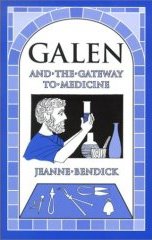
Galen and the Gateway to Medicine

This review originally appeared in the Summer 2003 issue of Catholic Home Educator, which is no longer published.

Galen and the Gateway to Medicine
(Living History Library)
Written and illustrated by Jeanne Bendick
2002, Bethlehem Books
152 pages


Archimedes and the Door of Science by Jeanne Bendick is not only a favorite among homeschoolers, but is also one of those books that has withstood the test of time. Originally published in 1962, it is one of Bethlehem Books’ bestsellers of today.

Now Jeanne Bendick has done it again. Though eighty-years old, Mrs. Bendick wrote and illustrated Bethlehem’s newest title Galen and the Gateway to Medicine. In the first week that this book was in my home, it was picked up and read by my three oldest children. I simply left it lying around as I wanted to read it myself, but every time I turned around a different child had taken it from under my nose.

The general consensus in my house is that Mrs. Bendick’s newest title is a hit. Just as she did with the Archimedes book, she brings an ancient character to life and shows us how his life and his work is still relevant today.

Galen was a Greek living in the times of Roman rule. A physician, Galen saw anatomy as fundamental. Based on his work as a surgeon to Roman gladiators, and his animal dissections (dissection of human corpses was forbidden), Galen described cranial nerves and heart valves and showed that arteries carry blood, not air as was believed at that time. In extending his findings to human anatomy he was sometimes in error, however his findings were the standard for the next 1,300 years.

Galen wrote nearly 300 works, of which about 150 survive to this day. As they were translated, his influence spread throughout the Christian and Muslim worlds. A revival of interest in Galen’s work during the Renaissance led to new anatomical studies. Many of his ideas were then overthrown when Andreas Vesalius wrote On the Structure of the Human Body (1543), which includes descriptions of the human anatomy, based on his own dissections. Later William Harvey correctly explained blood circulation in Anatomical Exercise Concerning the Motion of the Heart and Blood in Animals (1628).

Even though Galen’s theories had to be corrected, his philosophies, based largely on Hippocratic concepts, helped to create a foundation of respect for the human person and spirit in medicine.

Reading Jeanne Bendick’s latest book Galen and the Gateway to Medicine will provide many lessons for your homeschooled child, from science to history to philosophy. I highly recommend it.


JEANNE BENDICK, a graduate of Parsons School of Design, is the author and illustrator of many books, primarily in the field of science. Her work has always been distinguished by her remarkable ability to express complex concepts in simple language, and to make difficult subjects interesting and comprehensible to the general reader. Among her many books are Mathematics Illustrated Dictionary, How Heredity Works, Eureka! It’s Television!, The First Book of Space Travel, The First Book of Automobiles, and The First Book of Airplanes.