Thursday, November 30, 2006

More on Saxon and Geometry

I emailed Cathy Duffy and asked:

I have some questions on this topic: Aren't the geometry lessons in Saxon intertwined with other lessons? Is it easy to pick out the geometry lessons? Is there a resource somewhere that gives the lesson numbers to skip if a parent wants to replace Saxon geometry lessons with the Discovering Geometry?
And she replied:

You’ve identified the big problem with “skipping geometry” in Saxon. Geometry lessons and problems are intertwined throughout the lessons. A parent would have to go through in advance and mark off the geometry problems/lessons to be
skipped. (They’d probably want to also mark their answer keys so students aren’t tempted to try to skip challenging problems and tell mom that it was a geometry problem.

I actually thought it was more trouble than it was worth past
Algebra 1. So we jumped to a different Algebra 2 course rather than try to get back to Saxon. (Algebra 2 is where the heaviest geometry concentration is in Saxon.) Chalkdust and Algebra Classmate are good options for Algebra 2. Classmate is just being renamed—I’m waiting for final confirmation on that, but
it’s in 100 Top Picks.

Monday, November 27, 2006

Prayer for the Holy Father's visit to Turkey

Our parish is praying this every day at Mass during Pope Benedict's trip.

The following is taken from the Knights of Columbus here.

Spiritual Pilgrimage With Pope Benedict XVI

Prayer composed by Bishop William E. Lori, supreme chaplain, for the Spiritual Pilgrimage with His Holiness Pope Benedict XVI on his Nov. 28-Dec. 1 pastoral visit to Turkey.

Print Version of Prayer (pdf, 82 kb)


Heavenly Father, from whom every family in heaven and on earth takes its name, we humbly ask that you sustain, inspire, and protect your servant, Pope Benedict XVI, as he goes on pilgrimage to Turkey – a land to which St. Paul brought the Gospel of your Son; a land where once the Mother of your Son, the Seat of Wisdom, dwelt; a land where faith in your Son’s true divinity was definitively professed. Bless our Holy Father, who comes as a messenger of truth and love to all people of faith and good will dwelling in this land so rich in history. In the power of the Holy Spirit, may this visit of the Holy Father bring about deeper ties of understanding, cooperation, and peace among Roman Catholics, the Orthodox, and those who profess Islam. May the prayers and events of these historic days greatly contribute both to greater accord among those who worship you, the living and true God, and also to peace in our world so often torn apart by war and sectarian violence.

We also ask, O Heavenly Father, that you watch over and protect Pope Benedict and entrust him to the loving care of Mary, under the title of Our Lady of Fatima, a title cherished both by Catholics and Muslims. Through her prayers and maternal love, may Pope Benedict be kept safe from all harm as he prays, bears witness to the Gospel, and invites all peoples to a dialogue of faith, reason, and love. We make our prayer through Christ, our Lord. Amen.

Addendum to The Companion

In The Catholic Homeschool Companion, I wrote about using Saxon math.

I was very meticulous about editing the book, proofreading a hundred times, verifying facts, and researching recommended resources. However, as is true with any nonfiction book, mistakes still slipped through.

My faux pas was in quoting Cathy Duffy on the topic of geometry. You see, Saxon has no separate textbook for geometry. However, if you use Saxon through Algebra 2 and Advanced Mathematics, you will have the equivalent of one full year of Euclidean Geometry. In The Companion, I wrote that if you're uncomfortable with that scenario, you could supplement with Key To Geometry, as recommended by Cathy Duffy. That isn't accurate.

Cathy fortunately caught this and here is what she wrote to me:

I wanted to mention something now before I forget it. On page 21, you say that I recommend using Key to Geometry along with Saxon at high school level. Key to Geometry is really younger level. The program I recommend most is Discovering Geometry, published by Key Curriculum, the same folks who do the Key to series.

It's easy to get them confused. I've occasionally mentioned using Key to Geometry as an introductory supplement for a high schooler if they are really struggling getting the concepts AND if a parent is going to use everything in Saxon and really use Key to Geometry ONLY as a supplement.

My general recommendation is to skip the geometry in Saxon's books, and use Discovering Geometry instead. What you've got on p. 21 reads like it is ONLY a supplement so that's OK as far as it goes, but it should be clear that it is really an option appropriate for younger or struggling students since it's purely conceptual-no mathematical computations involved.


I'll contact the publisher so that future editions can be corrected. Thank you Cathy!

Saturday, November 18, 2006

New Heart Repair Treatment More Effective and Safer than Stem Cells

Neat stuff - read about it at the Dawn Patrol.

The treatment involves a protein called Thymosin Beta 4 - which was co-discovered by Dawn's dad!!!

Friday, November 10, 2006

Science Can't Explain It All, Says Benedict XVI

My friend Martha sent this... I especially enjoyed Benedict XVI's quote: "Man cannot place in science and technology so radical and unconditional a trust as to believe that scientific and technological progress can explain everything and completely fulfill all his existential and spiritual needs."

Calls for an Openness to Philosophy and Theology VATICAN CITY - Benedict XVI praised the extraordinary possibilities opened to humanity by science, but he cautioned that technology cannot explain everything.

The Pope expressed this today to members of the Pontifical Academy of Sciences, who are gathered in Rome for their plenary assembly. The theme of the assembly is "Predictability in Science: Accuracy and Limitations."

In his English-language discourse, the Holy Father said, "This increasing 'advance' of science, and especially its capacity to master nature through technology, has at times been linked to a corresponding 'retreat' of philosophy, of religion, and even of the Christian faith.

"Indeed, some have seen in the progress of modern science and technology one of the main causes of secularization and materialism: Why invoke God's control over these phenomena when science has shown itself capable of doing the same thing?"

"If we think, for example," he said, "of how modern science, by predicting natural phenomena, has contributed to the protection of the environment, the progress of developing nations, the fight against epidemics, and an increase in life expectancy, it becomes clear that there is no conflict between God's providence and human enterprise."

"Science, however, while giving generously, gives only what it is meant to give," Benedict XVI cautioned. "Man cannot place in science and technology so radical and unconditional a trust as to believe that scientific and technological progress can explain everything and completely fulfill all his existential and spiritual needs.

"Science cannot replace philosophy and revelation by giving an exhaustive answer to man's most radical questions: questions about the meaning of living and dying, about ultimate values, and about the nature of progress itself."


Read more here.

Monday, November 06, 2006

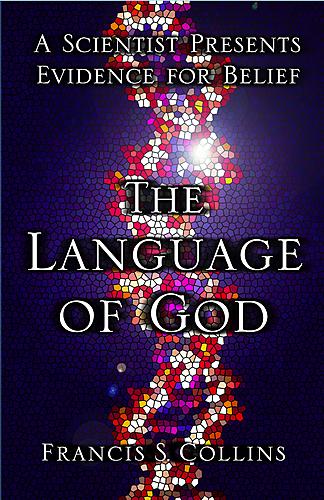
In this issue of Crisis: a review of The Language of God

The current issue of Crisis brings a review of the book by the well known head of the Human Genome Project, Francis S. Collins, entitled The Language of God. Juxtaposing Collins with "arch-atheist" Richard Dawkins, Benjamin Wiker's beefy review tells of Collin's conversion to evangelical protestantism and his troubles with the concept of ID aka Intelligent Design. At almost two pages, the review is filled with interesting facts and quotes, and also with a short presentation of the author's newly coined term: BioLogos.

Certainly a must-read review for readers who look to stay abreast of the current waves of the theistic evolution dialogue.

Illustration source here

Update: Time's cover article this week is about this book,
with a debate between Collins and Dawkins!

From the publisher's website:

Dr. Francis Collins, head of the Human Genome Project, is one of the world's leading scientists. He works at the cutting edge of the study of DNA, the code of life. Yet he is also a man of unshakable faith in God and scripture. He believes that God cares about us and can intervene in human affairs -- on rare occasions, even miraculously. Collins has personally discovered some of the scientific evidence for the common descent of all living creatures, even though he repudiates the materialist, atheistic worldview argued by many prominent Darwinists.

In short, Dr. Collins provides a satisfying solution for the dilemma that haunts everyone who believes in God and respects science. Faith in God and faith in science can be harmonious -- combined into one worldview. The God that he believes in is a God who can listen to prayers and cares about our souls. The biological science he has advanced is compatible with such a God. For Collins, science does not conflict with the Bible, science enhances it.

For many years Dr. Collins kept his views largely to himself, as he helped oversee the Human Genome Project's stunning sequencing of the code of life. Now, in what may be the most important melding of reason and revelation since C. S. Lewis's Mere Christianity, Dr. Collins explains himself in detail. The Language of God makes the case for God and for science. Dr. Collins considers and rejects several positions along the spectrum from atheism to young-earth creationism -- including agnosticism and Intelligent Design. Instead, he proposes a new synthesis, a new way to think about an active, caring God who created humankind through evolutionary processes.

He has heard every argument against faith from scientists, and he can refute them. He has also heard the needless rejection of scientific truths by some people of faith, and he can counter that, too. He explains his own journey from atheism to faith, and then takes readers on a stunning tour of modern science to show that physics, chemistry, and biology can all fit together with belief in God and the Bible. The Language of God is essential reading for anyone who wonders about the deepest questions of all: Why are we here? How did we get here? And what does life mean?

Find out more: Read an excerpt

Free Press, July 2006

Hardcover, 304 pages
ISBN-10: 0-7432-8639-1
ISBN-13: 978-0-7432-8639-8


Pope Benedict XVI on Science and Stewardship

"There is no conflict between true scientific progress and faith."

hat-tip Lapaz Farm Home Learning - (while you're there, check out her neat Biology resources and projects!)

Wednesday, November 01, 2006

A Mathematician, A Catholic and - A Witch

Check out the wonderful story of a female Catholic mathematician (and all-around smart lady!) from the 1700s. Click here for the story.